

It’s Preservation Week for libraries across the United States!
This year, we want to provide a glimpse into the crucial preservation work happening every day at the Bishop Payne Library by our book conservator, Beth Lewis.
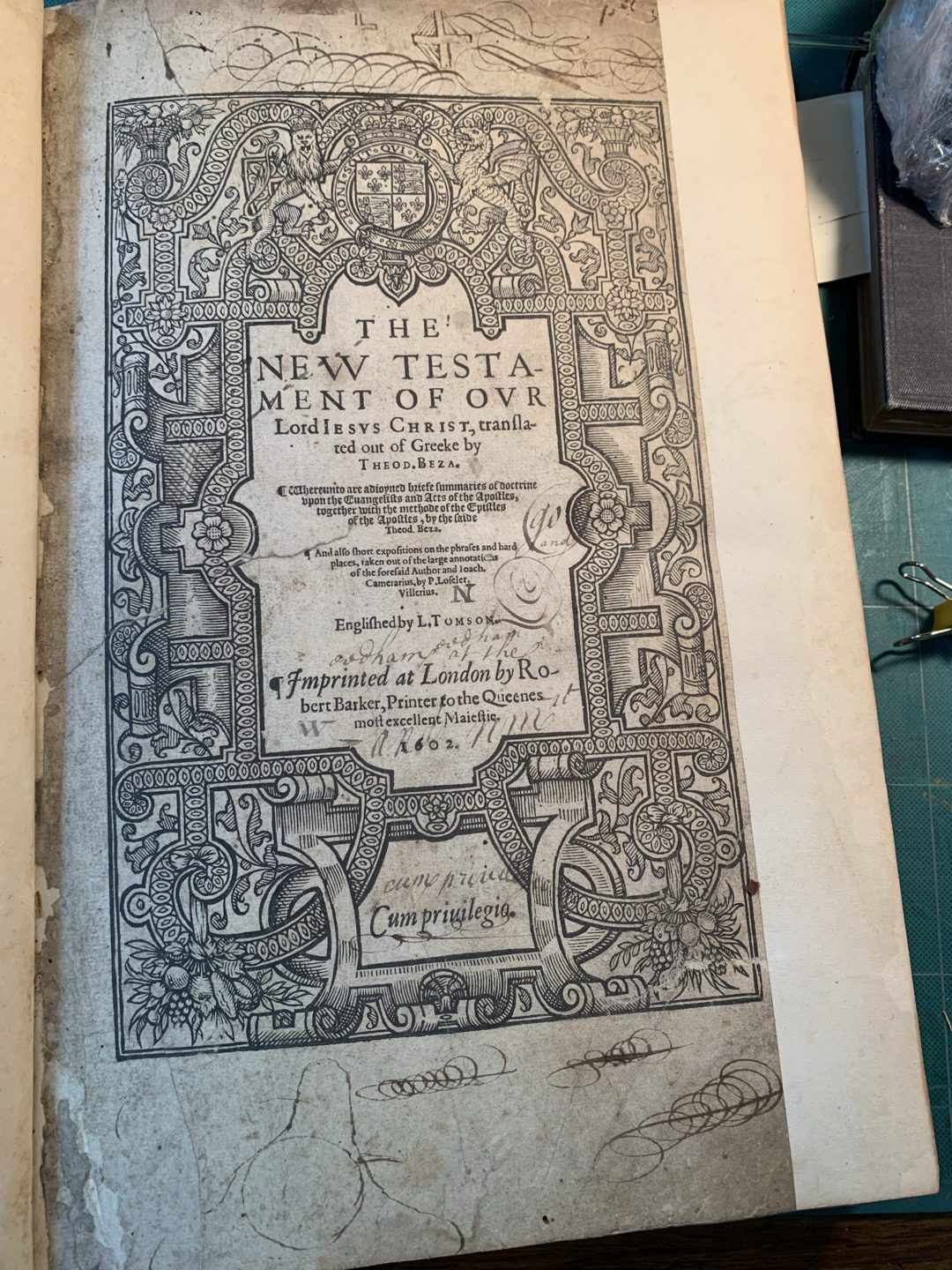 Today, Beth is working on preserving a 1602 English Geneva-Tomson New Testament from the library’s rare books collection. This New Testament is an English revision of the Geneva Bible by Laurence Tomson, or an “Englished” version as the title page puts it. Theodore Beza, who was the successor to John Calvin in Geneva, produced the original Latin translation in 1565, which was used to translate this English edition of the Geneva Bible. This edition includes annotations and notes by both Beza and Tomson. Tomson kept Beza’s unique translation of the Greek article “that,” which appears throughout the text – notably, in Rev. 1:11, “I Am Alpha and Omega, that First and that Last.” The publisher of this edition, Robert Barker, was the printer to both Elizabeth I and James I, and in 1611 printed the first edition of the Kings James Bible.
Beth’s Process
 Beth’s preservation work of this marvelous Bible will help ensure this book is available for researchers at the Bishop Payne Library for the next century or more. The binding and covers, though both previously repaired (likely in the 1800s), have extensive wear and tear (see images below). Book spine, binding, and cover repair are some of the most common preservation tasks for any library. If you were to walk into Beth’s office, you would see many different types of leather and cloths of all sizes and colors for this purpose. In this case of this New Testament, Beth will remove the old leather straps, carefully disassemble the spine, and then attach a new leather spine piece so the spine and covers are united once more. After this process, she will reattach the disassembled spine so those historical elements are preserved.
In this edition, note the scribbles on the cover page. Because paper was a rare commodity centuries ago, people would often test their pens and practice their penmanship on the only paper they had available: their Bibles!
The images below capture snapshots of Beth’s repair process.


—
For more information on this English New Testament, see David Norton, “English Bibles from c. 1520 to c. 1750,” in The New Cambridge History of the Bible, vol. 3 (Cambridge: Cambridge University Press, 2016), especially page 318.